
How to Identify a True Vintage Instrument: Tips from Industry Experts
Updated: Jan 29

Sometimes, a guitar arrives long before you spot its label or hear its story. I remember the first day an old L-5 found its way onto my bench - still carrying the faint aroma of stage smoke from statewide dance halls. Its lacquer checked in all directions, bridge worn smooth beneath a century's worth of palms. As I loosened the tuners—nickel clouded by time—I felt the echo of every chord played at grange parties and hallways thick with laughter. That moment laid bare a truth: genuine vintage instruments do not disguise their journey; they invite you, if humble enough, to listen for the music shaped across generations.
Authenticity matters far beyond price guides and auction blocks. As a restorer at Jimmy D's Vintage Instruments, I have watched musicians cradle a sixty-year-old Martin as though hearing its earliest concert. These instruments connect us—tangibly—to builders' hands and unsung performers whose hours refined voices are now rarely heard. When a piece is right—wood grain aging honestly beneath the finish, provenance traced in dusty ledgers—it resonates differently: firm under your fingers, brimming with life too layered for copies or mere reissues. Truth in vintage work serves both collector and player, safeguarding history while offering fresh inspiration to every owner that follows.
Discerning true vintage from clever replication asks more than sharp eyesight or lucky guesswork. Over decades and thousands of appraisals, I've distilled habits and details—a repertoire meant to protect buyers not only from costly mistakes but also from losing the irreplaceable connection only real instruments can give. What follows are practical insights rooted in conviction, shared so each musician or collector finds themselves holding a legacy—not just lumber and dreams—whenever they seek out their next rare companion.
Provenance and Story: The Soul of a Vintage Instrument
A vintage instrument rarely tells its own story out loud. Sometimes, the proof sits tucked beneath the finish—a handwritten ledger note hidden in an old Gibson's case, or a player's name carved lightly into the heel block of a Martin. A true instrument's soul is shaped over decades: every scar, replaced tuner, or lovingly handled knob bends its narrative in a way that a showroom piece cannot imitate.
Years ago, I helped identify a 1930s archtop that turned up in a Vermont attic—cocooned in dust and silence after its original owner, a caretaker once active in local swing bands, passed on. The family brought out faded receipts from prewar Boston music shops, along with yellowed dance photos showing the instrument onstage. These clues, combined with factory order numbers inked inside the f-hole, traced not just authenticity but the long arc of one player's journey. It's these tangled lineages—hearing about late-night jams, imagining decades of calloused hands—that elevate authentic vintage guitars beyond simple collectibles.
Unlike instruments anonymously traded online or through large-box retailers, those sourced by Jimmy D's Vintage Instruments learn their provenance by heart. By tapping into estate connections throughout New England—especially towns rich in generational history—Jimmy D has unearthed collectible musical instruments rarely seen outside small networks or private sales. Here, finding vintage isn't about luck; it's built atop handshakes at living room tables and careful listening to family lore.
This regional network gives each piece context and trust. Tracing the chain of ownership isn't just academic—nor is provenance a fancy detail for appraisers alone. When you hold an instrument selected this way, it offers more than playability: it delivers continuity with eras gone by, a tangible sense of legacy not possible with mass-market finds. The experience is as much about honoring what has come before as savoring tone wood or craftsmanship.
Every acquisition for Jimmy D's passes through rigorous vintage identification tips, yes—but at its core lies the conviction that you're adopting a chapter of ongoing musical history. Such care fosters connection and value that outlast trends or markets, giving every collector reason to ask: who tuned this string last? What songs linger still?
Physical Tells: Materials, Construction, and the Marks of Time
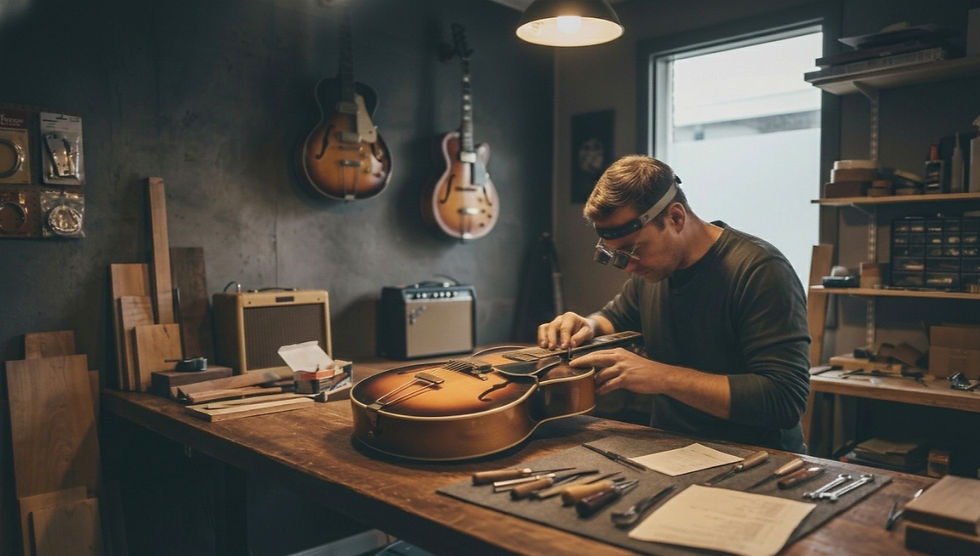
Every historic instrument carries physical evidence of its age and use - not just on the surface, but in every joint and groove. As a restorer and appraiser at Jimmy D's, I begin with touch and sight before any documentation. The specific woods used tell more than just a model name. For instance, a genuine 1950s Martin dreadnought will resonate with the glassy sheen of real Brazilian rosewood, its grain sporting brick-red streaks and subtle variance - no modern reproduction comes close under good light. Top woods mature, too: Adirondack spruce darkens and weathers to a caramel hue over decades of vibration and humidity cycles.
Finish tells its own story. Nitrocellulose lacquers from the '50s sink into grain lines and create webs of fine checking—those hairline cracks are often mistaken for accidental damage. On authentic vintage guitars, finish checking runs organically and never feels deliberate; it follows the temperature shocks from years of winter gig hauls or a hot trunk after Sunday service. Polyurethane finishes found on modern instruments settle smoother and resist this kind of aging. If you gently run a fingertip along the edge of old checking—a trick I learned watching luthiers older than myself—original lacquer remains cool, even slightly tacky, to the touch; refinish jobs lack this texture.
Sensing Time: Hardware, Wear, and Workmanship
Hardware never lies for long. Nickel-plated tuners from the mid-century dull unevenly, forming a patina that seeps into tight crevices or beneath screw heads, while high-gloss reissues rarely oxidize below where fingers can reach. An unmodified bridge saddle shows grooves formed by countless string changes; give the slot a close look under magnification - the chipping pattern and dust residue reveal whether it's original or swapped. Fret wear offers another window. Factory fret wire from the fifties flattens across chord-heavy spots—especially first through fifth positions for country or bluegrass tools—matching a player's style in ways fresh wire can't replicate.
Period-Correct Construction Techniques: Old dovetail neck joints reflect steady handwork; tooling marks may be faint, but they're never machine-perfect. Interior bracing—the topography inside a vintage Martin or Gibson—is knife-finished, sometimes with flattened glue spots from a hurried factory hand shift. Slotted truss rods don't appear in true pre-war builds.
Telltale Repairs: Close examination is vital. A skillfully repaired headstock leaves subtle fracture lines under blacklight, while replaced fingerboards sometimes float just above binding edges due to mismatched shrinkage rates over time.
Occasionally, one comes across an instrument whose minor repairs become part of its charm rather than cause for concern. An early-'60s Fender Jazzmaster came through Jimmy D's shop after decades beneath a Woodstock performer's bed. Its worn sunburst bore a spot refinish—clearly amateur, yet applied atop the original grain that still matched period photo references we tracked down with the family. That touch-up knocked some value, but didn't obscure the romance - nor its unmistakable feel when played.
On the contrary, overly 'clean' details raise alarms: pristine screws with broad Phillips slots on what should be slot-head hardware, bright chrome plating present where yellowed nickel ought to be, and pots dated much later than the guitar's serial stamp. Such cues have unmasked more than one convincing fake disguised with aftermarket badges.
Bridging Confidence Through Transparency
At Jimmy D's Vintage Instruments, every acquisition undergoes methodical inspection by myself and trusted luthier partners across Vermont. Process details form part of our video documentation included with each sale—showing construction quirks, explaining modifications, and highlighting value-impacting features transparently for collectors of collectible musical instruments. This open practice draws on decades spent learning when subtle sanding gives away a disguised crack fill or how oxidized saddles differ from wallet-fresh replacements.
The goal: equip clients not just with beautiful instruments, but respect for their quirks and confidence in their origins—a foundation as honest as aged spruce beneath lacquer.
Serial Numbers, Factory Codes, and Paper Trails: Decoding Authenticity
The search for authenticity winds deeper at the serial number and factory mark level. No two brands offer quite the same roadmap to verification—where Martin's hand-inked numbers blend into cedar heel blocks, a Gibson will stash its identity within stamped headstock codes or penciled order numbers, sometimes covered by old finish or a later overspray. Fender, ever the shape-shifter, has mixed numbering and neck 'pocket' dates, often inconsistent during high-demand years like 1965 - 66, when CBS-era transitions meant overlap and duplication on even consecutive builds.
During a routine evaluation, one 1940s dreadnought appeared every inch authentic until an internal stamp caught the eye: a faint "B" beside the order number. Only by cross-referencing this quirk against Martin's factory logs - and consulting a luthier friend in Hartford - did its fate resolve. The stamp signified an instrument meant for Boston distribution, built under a short-lived scale spec. Without archival access and regional context, details like these fade into noise; *context* shapes appraisal.
Serials rarely travel alone. Factory labels reveal more than brands intend—older Fenders sometimes sport misaligned decal fonts or odd kerning, themselves reliable tells against modern counterfeits. Gibson's orange oval stickers show changes in inking and edge gluing year over year; even paper texture can betray an ambitious forgery. With authentic vintage guitars, genuine paperwork—if present—brings needed weight, yet paper trails carry their limits: receipts get lost, dealer tags swap hands, and family tales stretch with each retelling. Clear provenance is gold; absence does not condemn.
Check serial number sequences against trusted archives for gaps or overprints common in transitional factory years.
Study date stamps, font irregularities, and label glue patterns using high magnification and archival resources.
Cross-reference old receipts or warranty cards with regional dealer histories when you suspect a New England-specific run.
Validate through luthier partners: skilled eyes detect headstock regluing or sanded-over stamps invisible to most buyers.
One Vermont consignment brought in a '59 Les Paul with a story: original purchase receipt showed Rutland's defunct Brown Music House as the dealer. The serial number aligned except for an extra digit - initially casting doubt. A careful check matched this anomaly to Gibson's practice of double-stamping switchovers that autumn, confirmed by contacts at Nashville's old plant archives. That inked slip of paper secured not just value, but connection to decades of regional musical heritage.
At Jimmy D's, appraisals dig past surface markers and extend through trade connections across seven states—and—initially far further in curiosity. This isn't work that tolerates shortcuts or loose assumptions; it requires alliance with historians, luthiers, and owners who've lived with these instruments for generations. Authenticity rests as much on narrative truth as on numbers behind the veneer.
Spotting Reissues, Forgeries, and Common Scams: Red Flags Every Buyer Should Know
Recognizing the Shadows: Reissues, Relics, and Reassembled Parts
Experience bends a critical eye toward the vintage market's masterful illusions—reissues sold as originals, relics engineered to mimic decades of play, and hybrid "parts guitars" cobbled together from disparate eras. Each wears its own disguise. Factory reissues, for example, often replicate cosmetic hallmarks so faithfully that even seasoned collectors sometimes pause. But a hair-thin line divides authentic vintage guitars from their tribute counterparts; true aging leaves chaotic patterns—unpredictable finish checking, oxidized metal where human hands once rested longest—that artificial relicing only hints at.
Reissued parts hold stories, thinking themselves complete. A well-worn 1962 Fender case turned up one spring at Jimmy D's, housing a Stratocaster with road-ready dings and a neck stamped 'March 62.' Something in the fretwork felt off—a little too level—sparking closer inspection. Under finish patina, a modern Wilkinson tremolo sat in place of what should have been a plainly functional original. Modern capacitors hid in the control cavity, poorly dated pot codes clashing with the otherwise convincing narrative. Parts guitars trick even skilled hands at times because wear can be transplanted; only scrutiny across every component uncovers mismatched histories.
Stories That Raise Suspicion
Once, I encountered an instrument pitched as an early-'50s Gibson ES through an estate sale referral. The lacquer wore spiderwebbing along plausible grain lines; patina streaked artfully around tuner buttons. Yet the storytelling faltered. The label text ink looked too sharp. Opening the pot's cavity revealed all shielding paint untouched—odd given arena-stage claims of countless cable swaps. Miles on the clock are hard to fake if you know where quiet mechanical details should bear witness.
Inconsistent wear patterns: Imperfect relic jobs create uniform dings or "roadworn" areas where real use would not reach; true playwear testifies in unexpected spots.
Modern wiring and hardware: Pot codes and cap styles inconsistent with expected production runs; new solder joints lacking dust or tarnish that matches age elsewhere.
Mismatched or period-inaccurate decals: Fonts too crisp for the era, misplaced logo placement, or telltale serial number fonts only seen on contemporary assemblies.
Peculiar provenance stories: Sellers unable to connect the dots between ownership changes or who present fuzzy paperwork paired with claims of rarity.
Mismatched finish chemistry: Heavy wear on lacquer surfaces with untouched poly finishes beneath, betraying spot refinishing or substitution.
Even expert eyes get tested by forgeries and clever retrofits—the best counterfeits borrow genuine finish craquelure but falter upon disassembly: modern screws nestled into perfectly aged bridges and truss rod nuts showing tool marks no collector would have left unpolished. It only takes one gap—the wrong saddle material under the low E string—to shift suspicion into certainty.
Vetting Each Find: Transparency in Practice
Decades inside repair benches shaped my process; at Jimmy D's Vintage Instruments, no acquisition stands without scrutiny shaped by collective experience and partnerships with trusted luthiers. Each instrument is vetted in stages—video walkthroughs before purchase capture honest first impressions, while detailed before-and-after photography reveals repairs or restoration moments that surface in closer light. Third-party verification means more than a technician's signature: we seek agreement from hands accustomed to both honest old glue drips and deliberate deception.
This approach erects meaningful barriers against typical scams seen elsewhere in collectible musical instruments: rushed sales with unclear documentation, cases closed to buyer inspection, vague origin explanations offered in place of solid chain-of-ownership detail. At every step—whether triggering skepticism over a reconfigured Telecaster bridge plate or double-checking old Martin heel stamps—transparency outpaces clever forgery.
In this world, no insurance policy protects like a diligent process backed by experience. While others gamble on hope or presentation, Jimmy D's insists each piece earns its story through openness, records, and restoration visible to any prospective custodian—securing not merely an instrument, but a thread of trust enduring far beyond the moment of sale.
Valuing the Authentic: Appraisals, Playability, and the Collector's Perspective
Value in the vintage world lives at the intersection of fact, feel, and legacy. Appraising an instrument calls for more than listing its age, brand, or rarity. True value coalesces from authenticity, documented lineage, and how an old guitar sings beneath your fingers—resonating with every skillful swipe and every hard-won repair. Provenance instills concrete worth, but it's originality and the instrument's preserved soul that draw collectors and players into lifelong pursuit.
A familiar scene at Jimmy D's: a dusty 1940s archtop arrives, tucked behind battered band cases. Its finish, unraveling gracefully with age, holds no promise of fortune on first glance. Closer work begins—pulling the pickguard to spot pencil marks only placed by the original maker, unscrewing tuners to reveal era-correct bushings patinated just so. Internal glue lines match mid-century handwork. Each cue reinforces not just age but integrity: the body untouched by unnecessary repairs, hardware true to catalog spec. The family's supplied gig shot—sepia-tinged and taken years before—serves as a final witness. Hidden among routine donations, this guitar emerges as a early post-war Gibson L-7; not couture rare, but authentic down to its binding stains and elegantly worn Florentine cutaway. Proper research anchors value; fair appraisal reveals a gem hiding in plain sight.
Balancing originality and restoration is delicate work. Replacing frets or skillfully resetting a neck demands professional transparency—a core tenet at Jimmy D's. Not every change is worth doing; essential repairs handled with correct period materials often safeguard tone and structural health. A bright, chiming OM guitar found in Cambridge arrived with a patched brace but all-original finish. Instead of burying imperfections beneath glossy reworks, we detailed every correction in the instrument's record and accompanying video walkthrough.
Market value rides tandem with playability. Collectible musical instruments lacking live sparkle or suffering tired fretwork may hold less allure than those loved yet well cared for. Jimmy D's setup process always extends to optimal string tension, clean electronics where applicable, and comfortable action—never "just as found." Every prospective owner deserves the confidence their acquisition will both sing immediately and endure years ahead:
Transparent appraisal: Each estimate references comparable sales but adjusts for regionally significant provenance or unique sonic attributes gained through honest play.
Professional setup: Action height, intonation, neck stability, and hardware function are finalized for both stage-readiness and preservation of original character.
Care guidance: Maintenance routines—humidification techniques for old spruce tops or correct cleaning for nitro finishes—are provided with every transaction.
Ongoing stewardship: Repeat clients often receive annual reminders or invitations for check-ups, ensuring investments remain playable and resilient as seasons turn.
The true collector views ownership as custodian work: protecting story while drawing joy from daily use. Details like a period-correct finish or an old strap button matter in the hands but fade beside that moment when an authentic vintage guitar wins you over with a voice matured by history itself. At Jimmy D's Vintage Instruments, each step—from first handshake on a local porch to final sale—inspires trust built on honesty and reverence. Here, value means standing behind every instrument chosen not only for market merit, but for its power to move a player - or entire gathering - for many years still in waiting.
Every genuine vintage instrument holds a voice shaped by decades of hands, care, and hidden stories—echoes of small-town dance halls, living room sing-alongs, or long-lost practice sessions late at night. What sets truly special pieces apart isn't only age or appearances; it is the integrity of their materials, the pocketed clues of their provenance, and the chain of trust that connects each caretaker along the way. The thrill lies in discovery—yes, in finding year-specific hardware or original finish under dappled light—but also in the responsibility to carry these artifacts forward with transparency and honesty.
Approaching an instrument—whether for purchase, appraisal, or restoration—demands equal measures of curiosity and caution. Unravel the facts behind serial numbers and scrutinize repair work, but never forget to listen for the story that rises from honest wear. In a market swirling with forgeries and faked paperwork, reliable guidance makes preserving musical heritage possible; shortcuts risk silencing these voices altogether.
If you desire professional eyes on your next acquisition, an honest second opinion, or a custom search rooted in connections nurtured across Rutland and throughout New England, Jimmy D's Vintage Instruments stands ready to help. Clients reach out easily by phone, direct email, booking form, or even a video walk-through - the same tools supporting trusted service nationwide. Whether you're searching for your dream collectible guitar, need skilled restoration for a family treasure, or plan to add a historic piece to your playing life, we meet you where authenticity and accessibility cross.
At heart, this business is more than transactions: it's about building honest relationships as stewards of sound and story. Each new partnership offers a chance to revive sound and history, one string at a time. Here, your journey through vintage carries forward with respect—and with the practical wisdom honed only by open collaboration and lifelong musical devotion.
Comments